


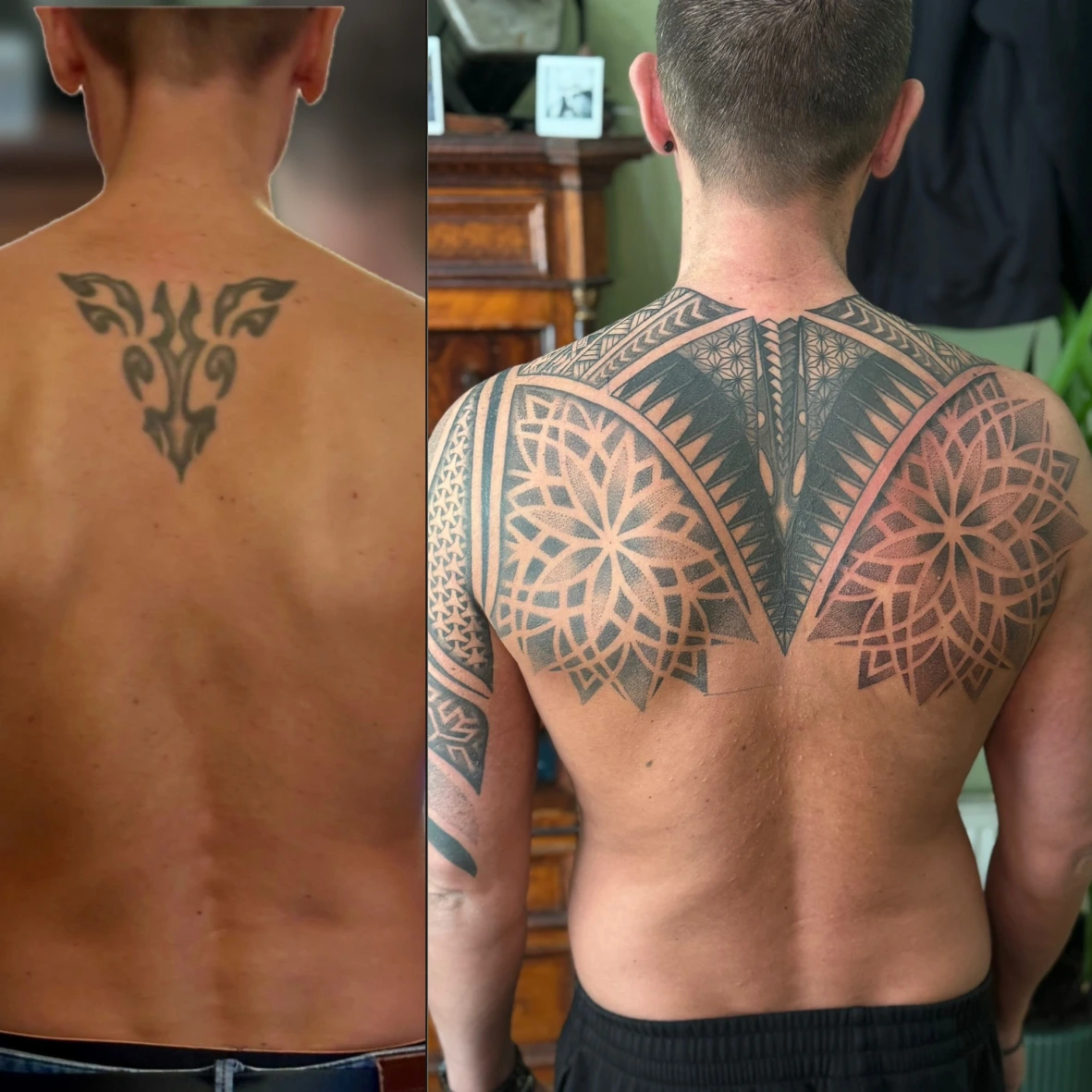
What a cover-up can actually achieve
A cover-up is not a second coat of paint that hides the existing tattoo like paint on a wall. Tattooing places pigment in the skin. When the same area is tattooed again, old and new pigment remain in the same tissue. Dark, densely packed lines therefore remain visually present—especially after healing, when redness, swelling and the saturated appearance of a fresh tattoo subside.
For the photos and details to include in your enquiry, visit Cover-Ups & Tattoo Rework.
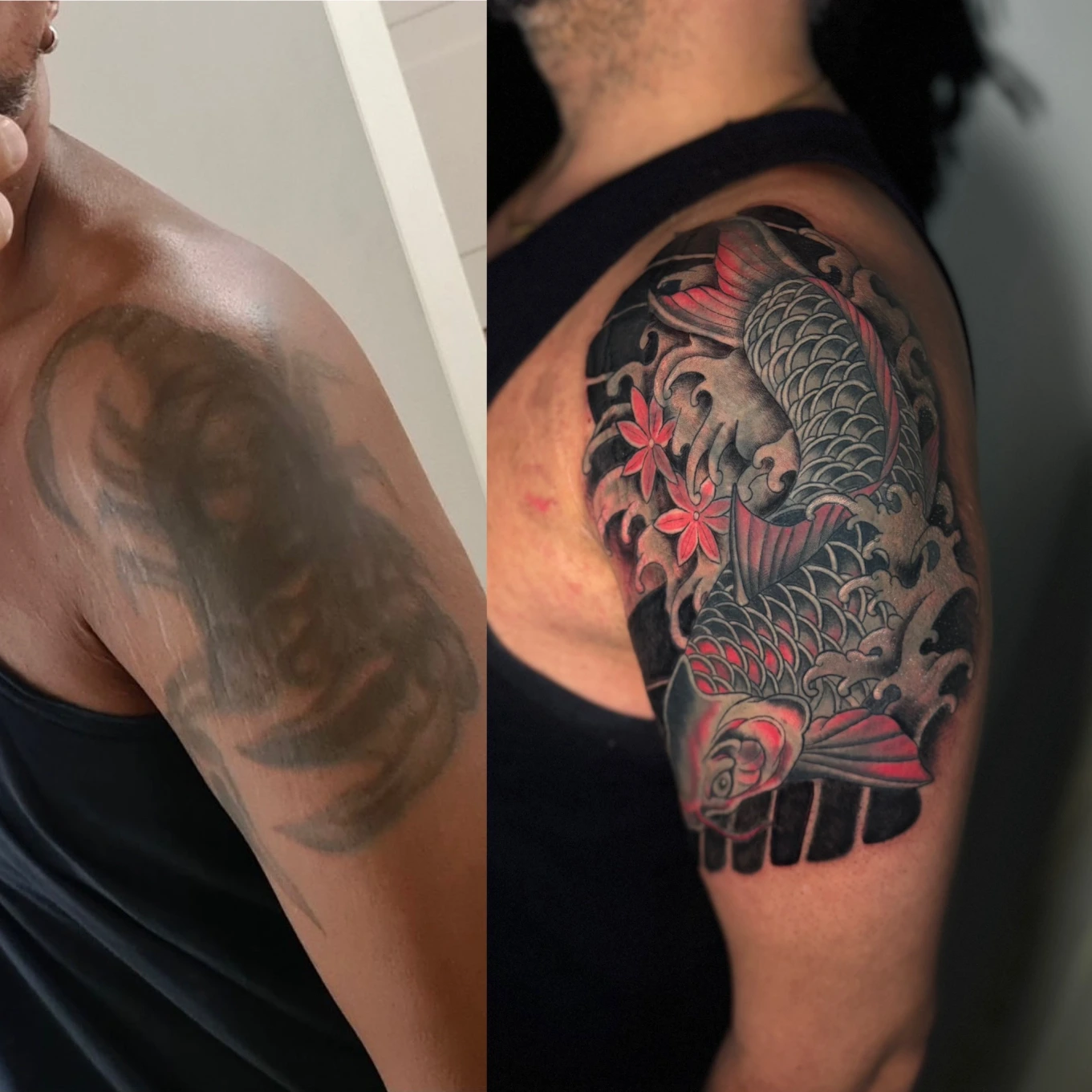
Concealment is created primarily through composition and visual direction. Dark elements of the old tattoo are incorporated into dark elements of the new design. Recognizable outlines are interrupted, crossed or transformed into new shapes. Lighter areas and important details are placed on untouched skin where possible. The eye should go to the new focal design first—not to the place where the old tattoo sits.
The core principle of a good cover-up
The old tattoo does not have to be tattooed over as dark as possible at every point. What matters is that its defining lines, letters or silhouettes can no longer be read as one coherent design.
A successful cover-up is therefore rarely limited to the exact outside edge of the old tattoo. If the new piece merely filled the same shape, the old silhouette would often remain visible as a dark block or frame. Additional space creates room for new outlines, lighter areas and a clear visual hierarchy.
Cover-up, rework, integration or laser?
Not every unwanted tattoo has to disappear completely. Before designing, it is important to define the result you actually want. Five different approaches are often grouped under the term cover-up even though they have technically different goals.
1. Complete cover-up
The old design is overlaid until it is no longer perceived as a separate image within the healed result. Size, direction, dark value distribution and design structure are rebuilt around a new composition. Even so, no serious artist can promise total invisibility in every light and from only a few centimeters away.
2. Rework or tattoo renewal
The basic idea of the existing tattoo remains. Outlines are refined, shading is added, contrast is reset or missing parts are extended. Reworking makes sense when the subject still feels right but the execution is weak, uneven or heavily faded. It usually requires less space than a complete cover-up.
3. Integration and extension
Usable parts of the old tattoo remain visible and are integrated into a larger composition. A single symbol can, for example, be extended into a sleeve, a floral arrangement or a Japanese-inspired piece. This solution is often stronger than trying to force every old line into hiding.
4. Blast-over
With a blast-over, the old tattoo deliberately remains partly visible. A new design—usually with a strong outline—is placed over it without aiming for complete concealment. The result depends on the visible overlap. This aesthetic is an intentional style choice, not a substitute for a fully concealing cover-up.
5. Laser-assisted cover-up
Instead of removing the entire tattoo, particularly dark lines, lettering or black blocks can be selectively lightened. Even a reduction in black density can open up new design directions, lighter transitions or a smaller final size. Laser treatment is a separate medical procedure and is not performed at the tattoo studio.
For a concise overview of this studio service, see Cover-Ups & Tattoo Renewal in Munich.
What determines whether a cover-up is feasible
The question “Can this be covered?” cannot be answered from the subject alone. Six factors are crucial to planning. Together, they determine how large, how dark and how flexible the new design can be.
1. Age and fading of the old tattoo
An older, visibly faded tattoo usually offers more room than a fresh, deep-black piece. The number of years alone is not what matters, however. Some tattoos lose contrast quickly while others remain dense despite their age. Touch-ups, sun exposure, pigment type and original saturation also change the starting point.
2. Black density and surface area
Fine grey lines can be incorporated differently from a heavy tribal band or an almost black rectangle. The larger the compact dark area, the more dark mass the new design must accommodate in that same place. It is not only the presence of black that matters, but also how evenly and densely it sits in the skin.
3. Color of the existing tattoo
Color tattoos are not automatically easier to cover. Pale yellow or washed-out pink may leave considerable freedom. A saturated dark blue, violet, green or red can strongly affect the color of the healed result. The new palette is therefore never chosen in isolation, but in relation to the existing pigments.
4. Line direction and recognizability
Names, dates, lettering, circles, crosses and geometric symbols often remain recognizable from only a few characteristic lines. A cover-up has to break precisely those visual axes. Irregular shading or organic shapes are often easier to integrate than a clear, symmetrical outline.
5. Placement and available untouched skin
On the upper arm, thigh, back or shoulder, the new design can expand in several directions. Space is limited on the wrist, ankle, fingers or behind the ear. A small old tattoo in one of these places can be technically more difficult than a larger design on a broad body area. Skin movement, curvature and neighboring tattoos also play a role.
6. Skin condition, scars and previous reworking
An old tattoo may also be scarred, previously reworked or too deep in places. Raised, shiny, hardened or sensitive areas must be assessed carefully before they are worked again. Active inflammation, open skin, growing scars or unexplained skin changes should never be tattooed.
Additional limits apply when the area also contains scars. The tissue should be assessed individually in the studio before any new work is planned.
Quick check before your consultation
Four honest questions help: How dark is the tattoo today? Which lines make it immediately recognizable? How much untouched skin surrounds it? And how flexible are you about the size, style and color of the new design?
Why a cover-up usually becomes larger
The familiar rule of thumb that “a cover-up must be twice as large” is too simplistic. There is no reliable fixed factor. Even so, the new tattoo often becomes larger because the added space serves specific design purposes.
- The outer outline of the old tattoo can be left behind and redefined.
- Lighter areas and negative space can be placed on previously untattooed skin.
- A new focal design can be placed beside or above the darkest area of the old tattoo.
- Old lines can be transformed into background, shadow, texture or secondary forms.
- The flow of the body can be considered instead of merely tracing the shape of the old tattoo.
The distribution of attention is especially important. If the old tattoo sits at the exact center of the new design and remains its darkest point, it often continues to attract the eye. Extending the cover-up allows a new focal point to be created on clear skin, making the old piece a subordinate part of the composition.
Larger does not automatically mean solid black. A good design uses the added space to distribute contrast. From a normal viewing distance, the result should remain easy to read rather than appearing as a compact dark patch. If you want to limit the final size, you will often need more flexibility in the design—or need to consider prior lightening.
Color, black density and the limits of light pigments
A cover-up is governed by value structure, not favorite color alone. The darkest areas of the old tattoo set a minimum for the darkest areas of the new design. A light pigment cannot reliably make a saturated black line disappear.
Why white ink is not an eraser
White or skin-toned tattoo inks do not restore natural, unpigmented skin. They can work as accents but change as the tattoo heals and ages. Dense black cannot be turned into stable, light negative space. Trying to “erase” a black tattoo with white ink therefore does not produce a predictable result.
Does every cover-up have to become black?
No. Color can work very well when the old tattoo has faded sufficiently, the new palette fits the existing colors and dark outlines or shadows support the design. A color cover-up usually needs clear contrast, however. Pastels, very light watercolor areas or subtle gradients are not a reliable way to conceal dark existing areas.
Why maximum darkness is not automatically better
A cover-up does not improve simply because every area is packed with black repeatedly. Too much darkness can collapse shapes and place unnecessary stress on the skin. A controlled distribution is more effective: dense areas where the old pigment requires them, and breathing room, structure or light in suitable adjacent areas.
The article Tattoo Colors and Longevity explains how black, grey and color age over time.
Which designs and styles are suitable for cover-ups?
The darkest style is not automatically the most suitable one. What matters is sufficient design flexibility. The new piece must be able to absorb dark zones, changes in direction and different areas coherently. The following styles often provide useful options, depending on the specific old tattoo.
Organic and floral designs
Leaves, flowers, feathers, animals, smoke, clouds, waves and other organic structures can follow existing lines. Different leaf sizes, fur, scales and shadows allow dark old areas to be incorporated where they technically need to remain. The design should not consist only of small decorative elements; it needs a clear main form.
Japanese and large-scale compositions
Japanese tattoos use a main subject, background and connecting elements such as waves, wind, smoke or flowers. These layers can integrate an old tattoo effectively into a larger composition. This creates considerable planning freedom on the upper arm, shoulder, back or thigh. Learn more about the structure on the Japanese Tattoos in Munich.
Blackwork and ornamental areas
Blackwork offers clear dark shapes and strong contrast. This is useful when the old tattoo already contains bold black elements. Negative space only works reliably where the skin is truly free or light enough; an existing black bar cannot become a light cutout. Examples of this visual language appear on the Blackwork Tattoos in Munich.
Black & grey and illustrative designs
Textures, fur, folds, stone, smoke and modeled shadows can break up old outlines. Very light grey shading will not cover dense black lines, however. A black-and-grey cover-up therefore needs dark anchor points and enough clear skin for light. Learn more about value structure under Black & Grey Tattoos in Munich.
Geometric, mandala and dotwork
Repeating patterns and segmented areas can transform old lines into a new rhythm. At the same time, exact symmetry reveals every deviation. If a dark old line runs through a planned light ring or clean negative space, the structure must be adjusted. Geometric cover-ups therefore work only with suitable anchor points. Technical fundamentals are explained on the Geometric, Mandala & Dotwork.
Fine line and minimalist designs
A small fine line design is rarely suitable for directly covering a clearly visible old tattoo. Fine lines carry too little visual weight, and light negative space cannot be created over dark existing pigment. Fine line can work as an extension on clear skin or may become an option after substantial laser lightening. It is not a dependable “light” layer over black.
When covering is not advisable
An honest refusal is part of professional cover-up work. Not every combination of old tattoo, desired design and final size can produce a result that will still look clear and balanced years later. In the following situations, the plan should be changed, postponed or replaced with another approach.
- The new design is meant to be smaller, lighter and more delicate than the old tattoo.
- Dense black areas are expected to disappear using only pastels, white or skin-toned ink.
- The outer edge cannot be extended even though the old silhouette remains clearly recognizable.
- The tattoo is still fresh, or the skin has not fully stabilized after treatment.
- There is inflammation, open skin, suspicious moles, growing scars or significant hardening.
- Several previous cover-ups have already created a very dark, uneven and scarred area.
- The expectation is that the old tattoo must be completely invisible in every light and at close range.
- There is no willingness to adapt the design, style, color or number of sessions to the technical starting point.
Even a technically feasible cover-up can be the wrong design decision. Choosing a large, dark piece only to make the old tattoo disappear immediately can leave you with a second result that does not suit you. In such cases, limited laser lightening or a carefully planned rework is often more sensible than a rushed complete transformation.
Laser lightening before a cover-up: when it can make sense
Complete tattoo removal is not required for a later cover-up. It is often enough to lighten specific problem areas: a thick black outline, a name, a central symbol or a compact block that would otherwise dictate the entire new design. This can make the cover-up lighter, smaller or more flexible in subject.
How strongly a tattoo responds to laser treatment depends on pigment color, density, depth, skin type and previous treatment, among other factors. Success cannot be guaranteed. Possible risks include burns, inflammation, pigment changes and scarring. The treated skin must heal completely before it can be tattooed again. There is no universal safe interval between the last laser session and tattooing; medical clearance and the actual condition of the skin are decisive.
Legal note for Germany
Under § 5 NiSV, laser removal or lightening of tattoos is reserved for licensed physicians with the required specialist training or continuing education. Germany's Federal Environment Ministry also highlights the risks and the need for a professional medical assessment.
Further official information: Safer Tattoo - Risks of Tattoo Removal and BfR: Questions and Answers on Tattoo Inks.
Clear roles are important: the tattoo studio can identify which old lines restrict the design most. The physician independently decides whether laser treatment is medically appropriate, which procedure may be suitable and when the skin can safely be worked again.
Cover-up consultation in Munich: how planning should work
A photo is enough for an initial assessment, but it cannot replace examining the skin in the studio. Images show black density and shape fairly well, while scars, raised areas, movement, skin tension and subtle color differences are easily missed. Thorough preparation is therefore important for a cover-up project at Tattooine Sayagata in Munich-Bogenhausen.
What information to send in advance
- A sharp, straight-on photo in neutral daylight, without a filter or strong reflection.
- A second photo from farther away showing placement, orientation and available space.
- Approximate measurements, the age of the tattoo and the date of its most recent rework.
- Details of previous cover-ups, laser treatments, scars, raised areas or sensitive spots.
- Two to four design directions that genuinely interest you, plus any subjects you want to exclude.
- An honest indication of how flexible you are about size, color and style.
What is assessed during the consultation
- The darkest old areas and the most recognizable main lines are identified.
- The skin is examined at rest and in motion; existing scars or previous work are assessed.
- Cover-up, rework, integration and prior lightening are compared to find the most sensible approach.
- Design direction, final size and the new visual axis are adapted to the shape of the body.
- Dark areas, lighter areas and important outlines are arranged so the old design loses its readability.
- Larger projects are divided into appropriate sessions and assessed only after complete healing.
A professional design is not created by digitally placing any requested image over the old tattoo. What matters is how it fits the real placement on the body. A design can look opaque on a screen while still having too little contrast, the wrong line direction or an unsuitable final size on skin.
Cost, sessions, healing and long-term longevity
What a cover-up costs
Price is not based only on the area of the old tattoo. The full new design, required final size, level of detail, color, placement, preparation and number of sessions all matter. A small old symbol may require a medium-sized new design, while a larger but very pale tattoo may offer comparatively more flexibility.
A flat figure would therefore be misleading. The article How Much Does a Tattoo Cost in Munich? explains how tattoo prices are generally calculated.
One session or several?
Small projects with favorable starting conditions may be completed in one session. Large compositions, high black density or sensitive skin can make several appointments more appropriate. Splitting the work is not merely a scheduling decision: it avoids overworking a difficult area in one session and allows the result to be assessed after healing.
Why the healed result matters
Immediately after tattooing, black and color appear especially saturated. Redness and swelling can alter contrast further. Only after full healing does it become clear how evenly the new pigment sits and whether individual old lines still show visually. A meaningful check generally takes place no earlier than about four to six weeks, and potentially later for stressed or scarred skin.
A touch-up is not an automatic part of every cover-up. First, it must be determined whether pigment is actually missing, an old line remains too dominant or an adjustment outside the old area would improve contrast more effectively. Repeatedly working the same place must not become a substitute for an unsuitable design.
For cleaning, ointment, exercise, sun and swimming, follow the general guidance on tattoo aftercare. Long-term UV protection helps keep contrast and color as stable as possible.
FAQ: Cover-Up Tattoo in Munich
Can every tattoo be covered?
No. Many tattoos can be reworked or covered, but not every requested combination is realistic. Dense black areas, pronounced scarring, very limited placement and the desire for a smaller, lighter design can rule out a direct cover-up.
Can a black tattoo be covered with color?
Partly, but not with arbitrarily light colors. Dark areas of the old tattoo must sit within sufficiently dark outlines, shadows or color fields in the new design. Color works best with a clear value structure and enough untouched skin for lighter areas.
Can white tattoo ink cover black?
White ink is not a reliable eraser. It does not restore natural skin tone or create stable, light negative space over dense black. White accents can be part of a design, but they should not carry the entire concealment.
How much larger does a cover-up need to be?
There is no fixed formula. The new design must be large enough to extend beyond the old outline, create new focal points and place lighter areas on untouched skin. Sometimes a moderate extension is enough; sometimes the design needs considerably more space.
Does the old tattoo need laser treatment before a cover-up?
No. Faded, small or favorably structured tattoos can often be reworked directly. Lightening can make sense when individual black lines or areas would otherwise restrict the new design disproportionately.
How long should you wait to tattoo after laser treatment?
There is no universally safe waiting period. The skin must be fully healed, calm and stable. The treating physician provides the medical assessment, and the area is evaluated again at the studio before tattooing.
Can a fresh tattoo be covered immediately?
No. Even if the design is disappointing immediately after the appointment, the skin must first heal fully and stabilize. Tattooing over it at once adds trauma and prevents a reliable assessment of the actual black density and any scarring.
Is fine line suitable for a cover-up?
Only for very light, small or significantly pre-lightened old tattoos. Fine lines have too little visual weight to reliably break up strong outlines or solid areas. Fine line work can often be used more effectively on adjacent untouched skin as part of an extension.
Can names or lettering be covered?
Often, yes. Letters are highly recognizable, however. The new design must deliberately break up their straight lines, curves and spaces. Floral, illustrative, ornamental or Japanese compositions often offer more options than a new small symbol.
Does a cover-up hurt more than a regular tattoo?
Not automatically. Pain depends mainly on placement, session length and individual sensitivity. Scarred or repeatedly worked skin can feel different and is treated more cautiously.
Can a tattoo that has already been covered be reworked again?
In principle, yes, but every additional layer of pigment reduces design freedom. Another direct cover-up may be unreasonable on very dark, repeatedly worked or scarred areas. In that case, reworking, extending or medical lightening should be considered.
How much does a cover-up cost in Munich?
The price is based on the complete new project: design, final size, style, placement, color and the sessions required. A reliable estimate is only possible after the old tattoo and the desired direction have been assessed.
Conclusion: a cover-up works when the design respects the starting point
An old tattoo cannot simply be overwritten with any new design. Existing pigments—especially the darkest lines and areas—remain part of the plan. Good cover-ups use this starting point deliberately: they redirect the eye, break recognizable outlines and distribute darkness, light and movement across a new composition.
A cover-up is appropriate when you are willing to adapt the subject, size and color to the technical conditions. It is less appropriate when the result must be smaller, lighter and more delicate than the existing tattoo. Reworking, extending or physician-led lightening may then provide a better foundation.
At Tattooine Sayagata in Munich-Bogenhausen, the first step is therefore to assess what the skin and existing pigment actually allow. Only then is a design developed that works not just in a fresh photo, but remains clear and coherent after healing.
Cover-Up Tattoo in Munich
Want a realistic assessment of your old tattoo?
Send unedited photos, measurements, the age of the tattoo and your design ideas. At the studio in Munich-Bogenhausen, we can determine whether a cover-up, rework, extension or prior lightening is the most sensible route.
Expert sources
- § 5 NiSV - physician requirement for laser tattoo removal.
- German Federal Environment Ministry - Safer Tattoo: risks of tattoo removal.
- German Federal Institute for Risk Assessment - questions and answers on tattoo inks.
- Laser Tattoo Removal: A Clinical Update. Peer-reviewed clinical article on laser tattoo removal.
- Immune Response in Laser Tattoo Removal: A Systematic Review. Systematic review of the immune response to laser removal.
Professional information last reviewed August 24, 2026. This article provides general information and does not replace medical advice.
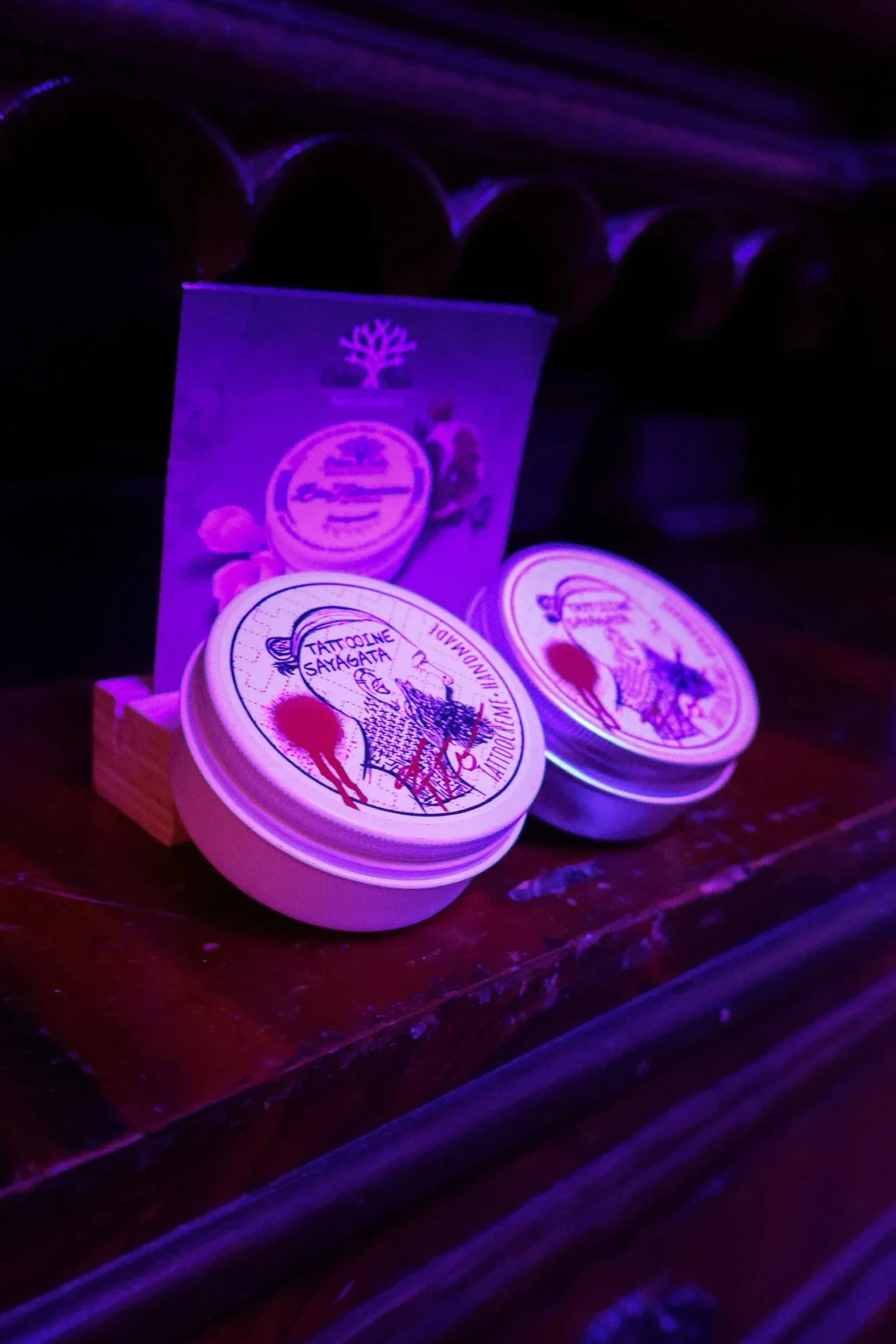
Tattoo aftercare: what matters after tattooing
Cleaning, cream, scabbing, sport, sun and swimming: the most important points during healing.
Read article
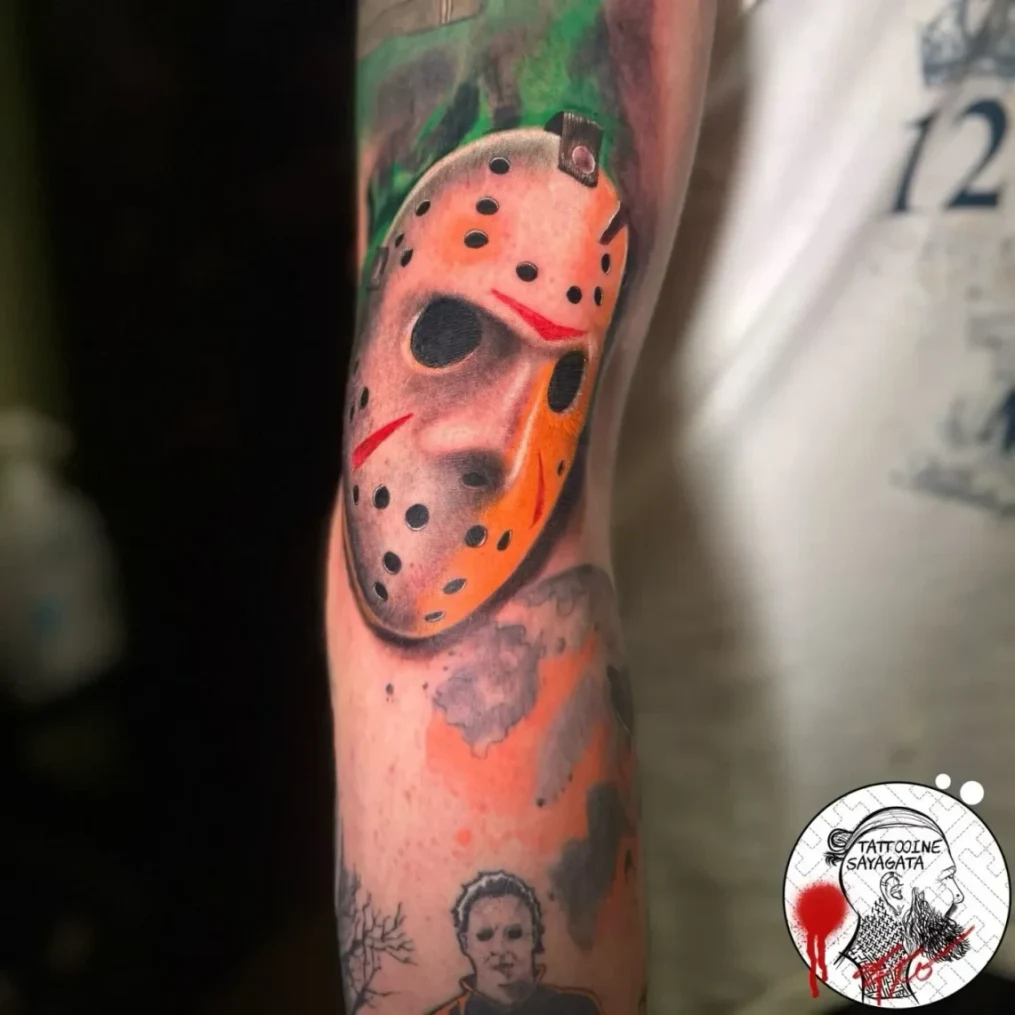
Tattoo colors and longevity: what matters long-term
How black, grey and color age, and how contrast, skin type, UV exposure and aftercare affect them.
Read article
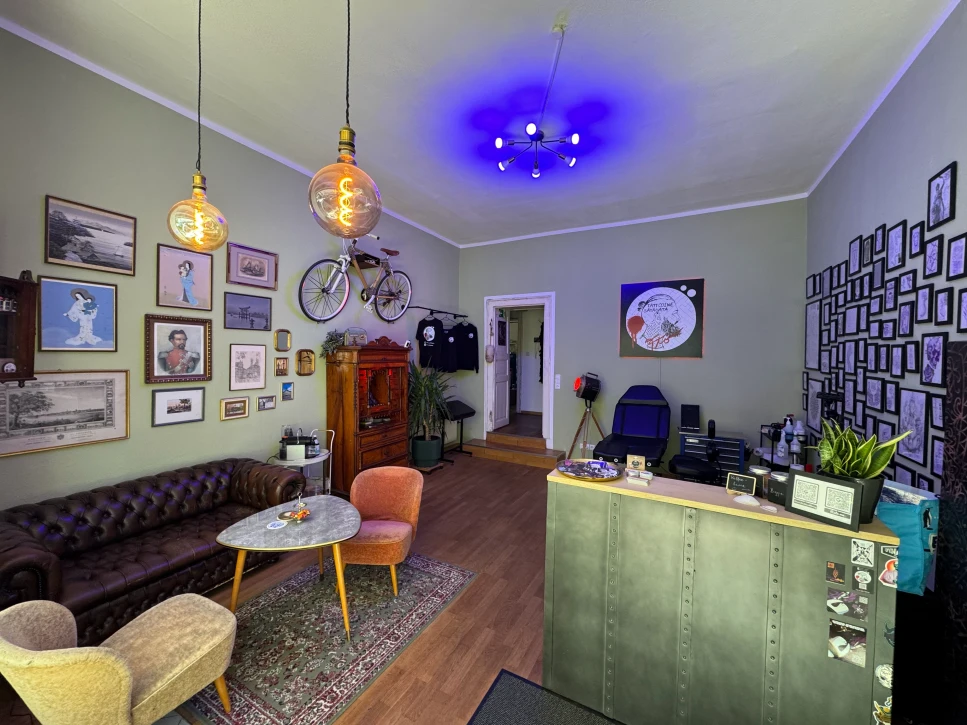
How much does a tattoo cost in Munich?
Which factors determine price and why a reliable estimate must be based on the complete project.
Read article